Handmade Crafts & Custom Goods

A handmade business sells more than objects. It sells gifting moments, identity signals, and the feeling that something was made with more care than mass retail can offer. The strongest Handmade Crafts and Custom Goods businesses usually win by pairing handmade products with clear made-to-order workflows, strong Custom Gifts positioning, and easy-to-understand buying reasons.

CreativeTrust-BasedRepeat Demand

This page helps you see the real split inside this category: some businesses are truly Handmade Crafts, while others are really Custom Goods, Custom Gifts, and made-to-order fulfillment systems. The stronger you are at telling those apart, the better your decisions get.

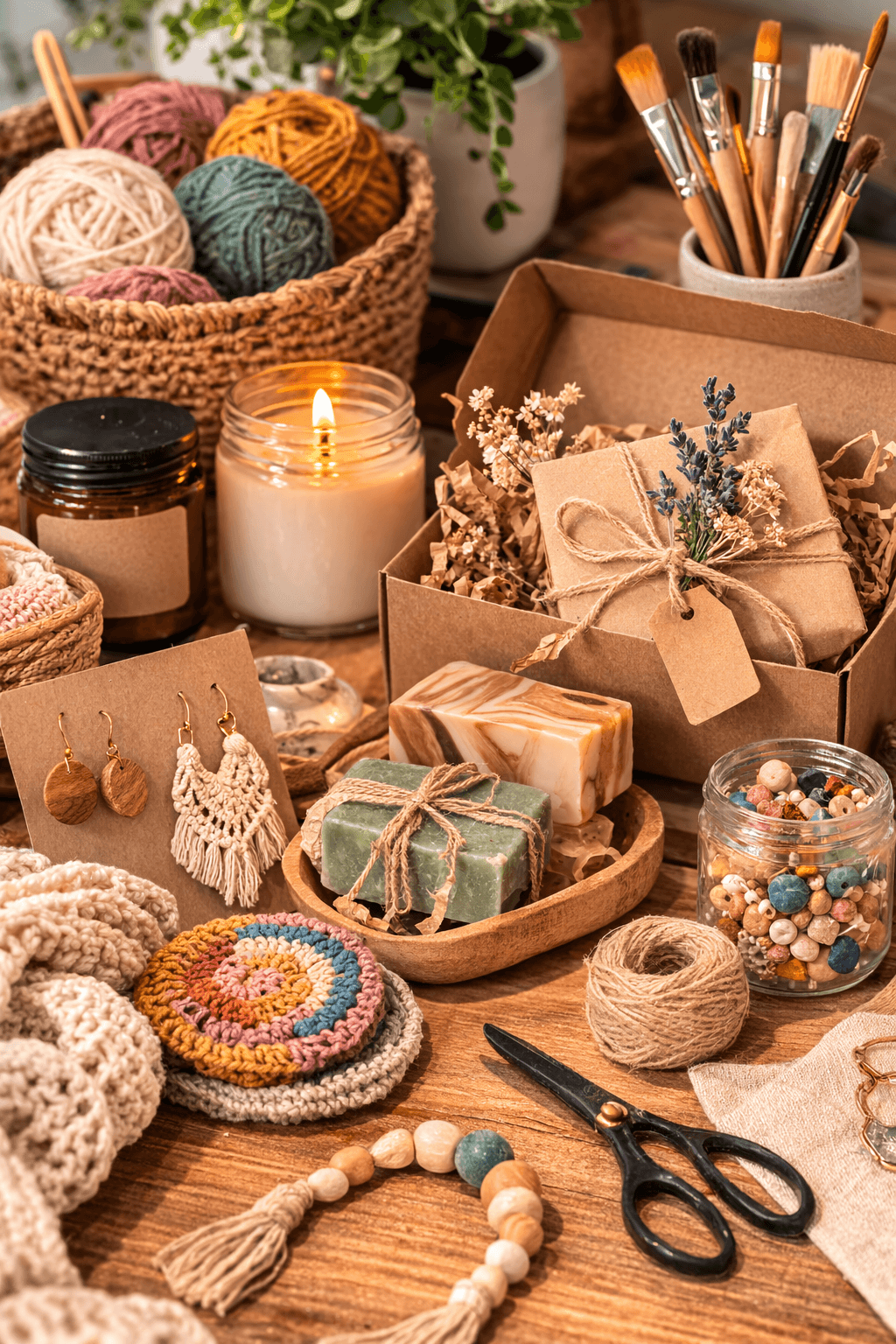
A small studio with handmade products, packaging materials, tools, and personalized items ready to ship

Quick Business Snapshot

Fast facts to help you grasp core traits quickly.

1

Startup Cost

Low to Medium

This is one of the easier product categories to test with limited capital. Costs rise fast only when the business depends on specialized equipment, deeper inventory, studio rent, or outsourced production.

Cheap to test does not mean cheap to run well.

2

Skill Barrier

Medium-High

The barrier depends on the model. True handmade work depends more on production skill and consistency. Custom Goods depend more on design judgment, offer clarity, personalization workflow, and fulfillment discipline.

Making something beautiful is only half the job. Delivering it reliably is the other half.

3

Time to First Revenue

Fast to Medium

A marketplace-first seller can often get early sales relatively quickly if the handmade products are clear, giftable, and easy to understand. Building stronger brand pricing usually takes longer.

It is easier to sell one custom gift than to build a remembered brand.

4

Repeat Potential

Medium

This is usually not classic subscription-style recurring revenue, but repeat buying exists around holidays, weddings, memorials, birthdays, babies, pets, home refreshes, and niche communities.

The strongest repeat engine is not loyalty by itself. It is life events.

5

Local Dependency

Low

Unlike most local service businesses, this category can sell nationally or globally from day one through online channels.

This business is usually discovered on a screen, not on a street.

6

Scalability

Model-Dependent

Pure handmade work scales slowly because the maker becomes the bottleneck. Design-led custom products, semi-automated production, and print-on-demand models scale faster.

The business becomes more scalable once every order no longer depends entirely on your hands.

7

Competition

Very High

This is one of the easiest product categories to enter, which means Handmade Crafts and Custom Goods get crowded quickly with hobbyists, side hustlers, copycats, low-cost sellers, and increasingly AI-assisted shops.

The category is not short on products. It is short on memorable positioning.

8

Operational Intensity

Medium-High

The visible work is making the item. The hidden work is listing quality, customer messaging, revisions, packaging, shipping, deadlines, seasonality, and constant product refresh.

A handmade business is usually part workshop, part photo studio, and part logistics desk.

Market & Demand Signals

This section helps show where demand usually comes from and what signals are worth noticing.

Demand Type

Gifting + self-expression + personalization + made-to-order relevance

Customer Pattern

Gift buyers, event buyers, niche community buyers, home-related buyers, and people looking for something less generic than mass retail

Service Format

Handmade goods, Personalized Gifts, made-to-order items, small-batch branded products, Gift Boxes, Gift Sets, and custom print-on-demand products

Handicrafts

The broader handmade economy is already large

Grand View Research estimates the global handicrafts market at $739.95 billion in 2024 and projects it to reach $983.12 billion by 2030. That is much broader than one small Handmade Business, but it confirms that Handmade Crafts and handmade products sit inside a very real consumer market.

The question is usually not whether demand exists. It is whether your handmade offer is specific enough to win.

Platform Demand

Custom and made-to-order demand is clearly visible on Etsy

Etsy reported 86.5 million active buyers, 5.6 million active sellers, and $10.46 billion in Etsy marketplace GMS in 2025. Its 2025 annual report also says custom or made-to-order merchandise made up about 30% of total GMS, and its buyer surveys found 31% of recent visits involved looking for something custom or personalized. That is exactly the kind of demand Handmade Crafts, Custom Goods, Custom Gifts, and Personalized Gifts are trying to capture.

That does not make Etsy easy. It does show that demand for Custom Gifts and made-to-order products is real, not theoretical.

Scalable Layer

The custom-products side is growing faster than pure handmade

Grand View Research estimates the global print-on-demand market at $10.78 billion in 2025, with a path to $57.49 billion by 2033. That matters because a growing share of Custom Goods businesses now combine creative design with outsourced or systematized fulfillment.

A lot of modern Custom Product Business models are really hybrid businesses.

Buying Moment

Personalized gifting is a meaningful submarket on its own

ResearchAndMarkets / Global Industry Analysts values the personalized gifts market at $37.8 billion in 2024 and projects it to reach $52.8 billion by 2030. That is a reminder that buyers are often purchasing emotional relevance, not just product utility. Personalized Gifts, Handmade Gifts, Unique Gifts, Gift Boxes, and Gift Sets all benefit when the buying reason is obvious.

A buying moment usually converts better than a broad product category.

Quick Reality Check

Before you take this idea seriously, check these real-world signals first.

01

Are you building a craft business or a product system?

Those are not the same business. A craft-led business wins on skill, finish, and taste. A Custom Product Business often wins on offer design, speed, giftability, and fulfillment reliability.

Pick the model first. Otherwise pricing, hiring, and growth all get confused between Handmade Crafts and Custom Goods.

02

Can your pricing survive the labor hidden inside personalization?

A product that looks simple on the listing page can contain edits, proof approvals, message threads, custom text changes, and rework that quietly crush margin, especially in made-to-order Custom Gifts.

Run your pricing on real order time, not ideal order time.

03

Are you solving a buying moment, or just making nice objects?

In this category, emotional context often matters more than raw craftsmanship. Weddings, memorials, babies, birthdays, pets, home moves, and fandoms usually convert better than generic beauty alone. That is why Unique Gifts and Personalized Gifts often beat broad handmade catalogs.

Look at whether the product fits a real reason to buy right now.

04

Are you too dependent on one platform?

Marketplace traffic is useful, but a business that lives entirely inside one platform becomes vulnerable to fees, ranking changes, and policy shifts.

Look at how much of your revenue, customer attention, and repeat demand is controlled by a platform you do not own.

What People Often Underestimate

Parts of this idea may look simple at first but become heavy in daily delivery.

Seasonality

A lot of the money is event-driven

Many handmade and custom goods businesses feel strong during holidays, wedding season, or gifting peaks and much thinner the rest of the year. Handmade Gifts and Custom Gifts often surge on a calendar rather than on a smooth monthly curve.

Customer Service Load

Customization multiplies communication

Spellings, colors, proofs, rush shipping, personal notes, Gift Wrap requests, and last-minute changes all add invisible workload.

Sameness Risk

The market gets crowded fast

Once one product style works, similar listings appear everywhere. Competing only on visuals is fragile unless the Handmade Business also owns a niche, a story, or a process advantage.

Fulfillment Drag

Packaging and shipping can quietly become part of the product

In gift-driven categories especially, the unboxing experience, Gift Wrap quality, lead time, and delivery reliability affect reviews almost as much as the item itself.

Startup Cost

What you may need to spend before this idea becomes real.

Cost Pressure

Low to Moderate

Testability

Very High

Cost Structure

Materials or supplier costs + tools/software + packaging/shipping + marketplace fees + marketing

Lean Start

This category can be tested without much cash

A seller can often begin with a few focused handmade products, basic photos, a clear offer, and a marketplace storefront before spending heavily on inventory or a standalone brand.

That is a real advantage, but it also means many weak Handmade Crafts stores enter the market just as easily.

Fees & Friction

Platform fees and order friction matter early

In marketplace-driven models, fees, customization messages, packaging, Gift Wrap requests, and shipping mistakes can eat margin long before the seller notices.

The business often feels simple until the admin starts piling up.

Price Ladder

The market supports multiple ticket sizes

Small Personalized Gifts, digital custom items, premium custom pieces, Gift Boxes, Gift Sets, and higher-end handmade work can all coexist in this category. That is why positioning matters more than category name alone.

The stronger the buying reason, the more room there is for healthy pricing.

What This Idea Really Asks of You

Done matters more than perfect in early stage execution.

Running Handmade Crafts or Custom Goods well means thinking like both a maker and an operator.
1

You need taste plus restraint

The strongest products in this category are usually not the most complicated ones. They are emotionally relevant, visually clear, and easy to buy for a specific person or occasion, especially when positioned as Custom Gifts or Personalized Gifts.

A sellable product is often clearer than the maker's imagination first wanted.

2

You need tolerance for repetition

A lot of the business is doing similar work well over and over: making, editing, packing, labeling, answering, gift wrapping, and shipping.

The romantic side of making things is only part of the job.

3

You need commercial judgment

You need to know when a product is art, when it is a gift, and when it is a SKU. That affects pricing, naming, photography, and whether the Handmade Business stays craft-led or becomes scalable.

Not every beautiful object is a good business object.

4

You need channel clarity

Marketplace-first, DTC-first, wholesale, and custom order models each reward different strengths. Mixing them too early often creates confusion and weak execution in a Craft Business.

A clear route to market is part of the product strategy.

How This Idea Usually Grows

Many ideas do not start at scale; they stabilize first.

1

Own one buying moment first

Do not begin with 'I sell handmade products.' Start with one clearer buying moment: wedding gifts, memorial goods, pet portraits, baby keepsakes, custom home pieces, gamer decor, or one narrow fandom niche.

Reminder: A buying occasion usually converts better than a broad category.

2

Turn one bestseller into a family, not a catalog

The healthier version of the business usually expands sideways from a proven winner: same buyer, same theme, different formats or price points such as Gift Boxes, Gift Sets, or premium Handmade Gifts.

Reminder: Depth usually beats variety early on.

3

Decide what stays handmade and what gets systematized

The business gets stronger when the founder is honest about which parts require real craftsmanship and which parts can be templated, outsourced, or fulfilled on demand.

Reminder: Scaling does not always mean making less. Sometimes it means touching fewer unnecessary steps.

AI / Automation Angle

Where AI can assist and where human delivery still matters.

Can Be Assisted

Product mockups, listing copy, SEO tags, customer-response drafts, proof generation, inventory planning, and trend scanning

Still Needs Human

Taste, material judgment, actual handmade craftsmanship, personalization quality control, and brand feel

Overall Role

A leverage layer around the product, not the soul of the product

Operations

AI can help reduce small order frictions

Listing titles, keyword variants, draft replies, simple proofs, and repeat customer messages can all be produced faster once Custom Goods orders start flowing.

Useful because admin work expands faster than most makers expect.

Product

AI can help test concepts before physical sampling

Mockups, style directions, and product variations can be explored before the seller spends money on materials or outsourced samples for a new handmade line.

Helpful for speed, but weak taste still produces weak products faster.

Sources & Usage Notes

This page prioritizes easier-to-verify market-size estimates, official Etsy disclosures, and clearly separated editorial synthesis. Platform metrics and market-size numbers are source-backed; startup framing, Handmade Business growth logic, and some operating judgments are editorial synthesis.

Core Sources

Grand View Research, Etsy 2025 annual report / investor release, ResearchAndMarkets / Global Industry Analysts

Data Nature

Mix of broad handicrafts market data, custom-products infrastructure data, official platform metrics, and personalized-gifts market sizing

Global Market Size

Grand View Research - Handicrafts Market

Supports: Global handicrafts market at $739.95B in 2024, projected to reach $983.12B by 2030.

Key point: Grand View Research estimates the global handicrafts market at about $739.95 billion in 2024, with projected growth to about $983.12 billion by 2030.

View source →
Custom Products Submarket

Grand View Research - Print on Demand Market

Supports: Global print-on-demand market at $10.78B in 2025, projected to reach $57.49B by 2033.

Key point: Grand View Research estimates the global print-on-demand market at about $10.78 billion in 2025, with projected growth to about $57.49 billion by 2033.

View source →
Platform Size / Buyer Intent

Etsy 2025 Annual Report / 10-K / Investor Results

Supports: 86.5M active buyers, 5.6M active sellers, $10.46B Etsy marketplace GMS in 2025, about 30% of total GMS from custom or made-to-order merchandise, and 31% of surveyed recent visits looking for something custom or personalized.

Key point: Etsy reported 86.5 million active buyers and 5.6 million active sellers at the end of 2025. The buyer-intent claims around custom and personalized shopping should be treated as company-reported marketplace context rather than an independently standardized market measure.

View source →
Personalized Gifts Market

ResearchAndMarkets / Global Industry Analysts - Personalized Gifts

Supports: Personalized gifts market at $37.8B in 2024, projected to reach $52.8B by 2030.

Key point: ResearchAndMarkets says the global personalized gifts market was valued at about $37.8 billion in 2024 and is projected to reach about $52.8 billion by 2030.

View source →
The strongest version of this business is not 'I make nice things.' It is 'I sell emotionally relevant products in a format that is easy to understand, easy to order, and repeatably profitable to fulfill.' The weak version is scattered creativity with no clear buying moment. The strong version knows whether it is competing on Handmade Crafts, Custom Goods, Custom Gifts, speed, or story - and prices accordingly.
This category works best when the founder is clear about whether the offer is primarily handmade, made-to-order, or a scalable Custom Goods system. Buyers looking for Unique Gifts, Personalized Gifts, Handmade Gifts, Gift Boxes, or Gift Sets do not reward confusion.

Keep exploring at your own pace

You do not need to decide now. Save it, note it, and compare more ideas.

Explore more ideas

Share this idea