1
Startup Cost
High
Even a small brewery needs serious money for brewhouse equipment, tanks, glycol, refrigeration, drains, permits, and taproom buildout.
Read As
This is not a cheap 'craft' business.
A small craft brewery is usually three businesses at once: a production business, a hospitality business, and a local brand. The beer matters, but the model only gets stronger when the taproom becomes part of people's routine, not just a place they try once.
The strongest small breweries do not win by brewing more beer. They win by earning more from each barrel through their own room, their own crowd, and their own repeat customers.
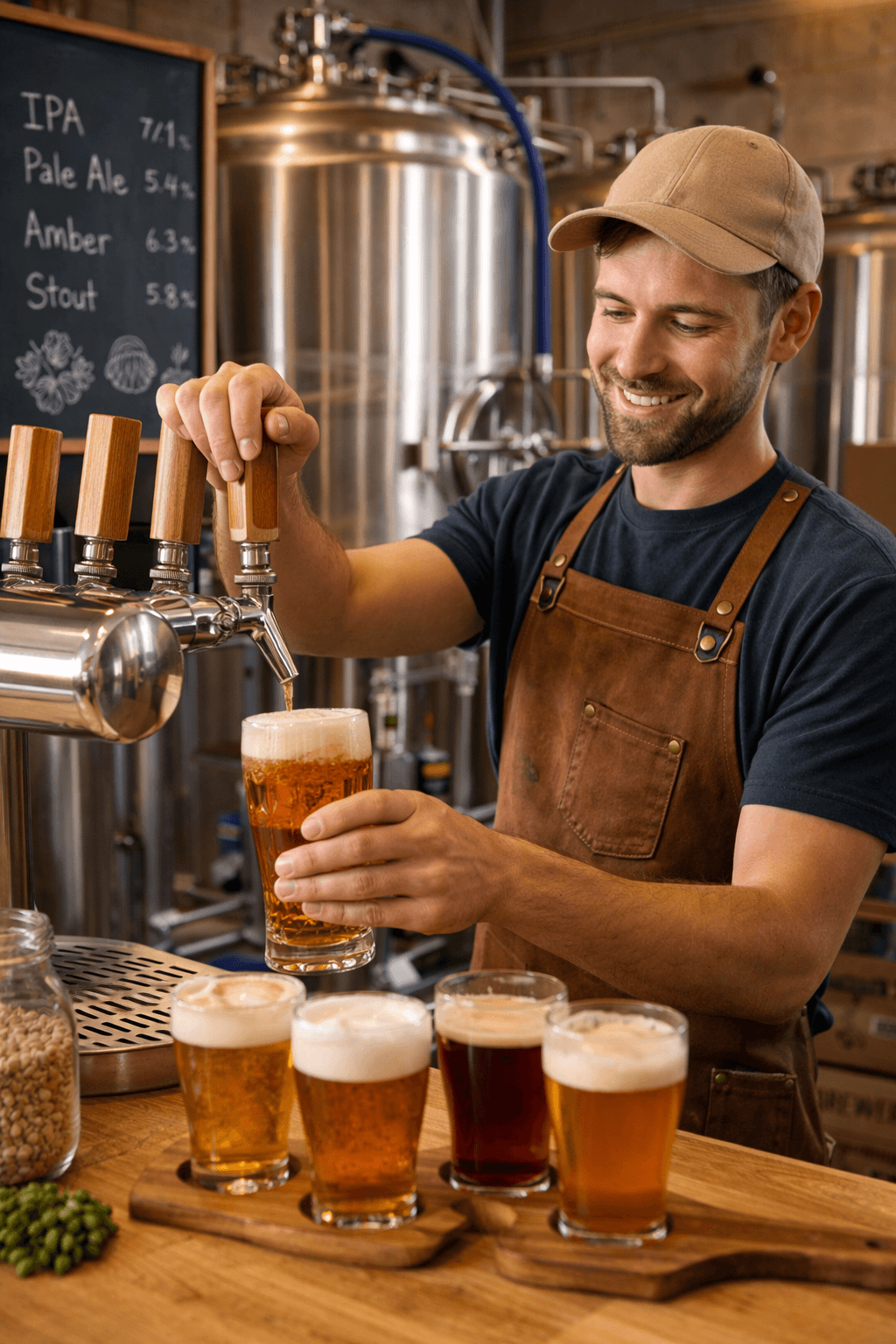
Fast facts to help you grasp core traits quickly.
Startup Cost
Even a small brewery needs serious money for brewhouse equipment, tanks, glycol, refrigeration, drains, permits, and taproom buildout.
Read As
This is not a cheap 'craft' business.
Skill Barrier
You need brewing skill, cellar discipline, compliance awareness, hospitality standards, and real cost control.
Read As
A good brewer is not automatically a good brewery owner.
Time to First Revenue
Beer can sell fast once the doors open, but licensing, buildout, and production readiness usually slow the path to first real revenue.
Read As
The pre-revenue phase is longer than many founders expect.
Repeat Potential
Taproom regulars, seasonal releases, mug clubs, events, and limited drops create strong return behavior.
Read As
The best breweries create habit, not just hype.
Local Dependency
Small breweries usually win locally first. Neighborhood fit, parking, foot traffic, and event energy matter heavily.
Read As
This is a local business before it is a brand story.
Scalability
You can grow through more tanks, second rooms, distribution, or events, but each path adds complexity fast.
Read As
Scaling production is easier than scaling a good taproom.
Competition
Customers can choose other breweries, bars, canned craft, cocktails, wine, RTDs, non-alcoholic options, or simply stay home.
Read As
Beer no longer owns the social occasion by default.
Operational Intensity
The pint is the visible part. The hidden part is sanitation, brewing schedules, staffing, inventory, events, draft lines, and equipment risk.
Read As
A full taproom can still hide a fragile operation.
This section helps show where demand usually comes from and what signals are worth noticing.
Demand Type
Customer Pattern
Service Format
Grand View Research estimated the global craft beer market at about $92.2 billion in 2023 and projected it to reach roughly $178.6 billion by 2030. On-trade was the larger channel, which supports a taproom-led model.
The category is large. The easy-growth phase is not.
The Brewers Association reported U.S. craft volume down 4% in 2024 while retail dollar sales still rose to $28.8 billion. That is a sign of a mature market where experience, pricing, and direct sales matter more than novelty alone.
The lane is real, but it is not easy.
The Brewers Association tracked 268 openings and 434 closings in 2025, with 9,778 small and independent breweries in operation. This is now an operations-and-discipline market, not a novelty market.
Good beer is no longer enough by itself.
Before you take this idea seriously, check these real-world signals first.
Those are related but different businesses. One lives on barrels and process. The other lives on hospitality and repeat local traffic.
Check: Decide which engine leads the economics before you design the room, staff, and growth plan.
A few great pilot batches do not prove the business. Consistency under scale, staffing stress, and seasonal demand is what customers remember.
Check: If quality control depends on the founder touching everything, the business is more fragile than it looks.
Taproom pours, packaged take-home, food, private events, and wholesale all behave differently economically.
Check: Track margin by channel, not just total sales.
Parts of this idea may look simple at first but become heavy in daily delivery.
Brewhouse systems, tanks, utilities, and buildout cost real money long before the brewery earns local loyalty.
Small breweries are no longer only competing with other breweries. They are competing with cocktails, wine, RTDs, low-ABV options, non-alcoholic drinks, and lower-frequency drinking habits.
For many small breweries, the healthiest version is a strong neighborhood taproom with events and direct sales, not an aggressive wholesale story.
What you may need to spend before this idea becomes real.
Cost Pressure
High
Testability
Medium-Low
Cost Structure
Brewing equipment + buildout/utilities + licensing/compliance + labor + raw materials + working capital
Current startup guides place many brewery openings around $500,000 to $1.5 million, with smaller microbrewery concepts often starting at $250,000 or more depending on model and buildout.
Brewing cannot be improvised cheaply for long.
GHJ's benchmark gross margins strongly favor taproom beer over wholesale: about 75% for taproom beer, 60% for draft distribution, and 40% for packaged beer.
That difference explains most of the modern small-brewery strategy.
Done matters more than perfect in early stage execution.
You need to care deeply about consistency, cleanliness, freshness, and whether the beer earns trust more than once.
Reminder: One off batch can damage many future visits.
Breweries run on cleaning, moving, checking, packaging, restocking, line maintenance, and timing. The glamorous moments are only a small part of the week.
Reminder: If you dislike repetition, this business gets harder fast.
The strongest small breweries become places people identify with, recommend, and choose for gatherings.
Reminder: Local identity is part of the product.
Many ideas do not start at scale; they stabilize first.
Do not try to be a hazy-hype brewery, a lager house, an event venue, a food destination, and a packaged-beer brand all at once. Pick the lane that fits your real economics.
Reminder: Focus beats breadth early.
The healthier version of a small brewery usually wins by turning first visits into local habit through reliable beer, a good room, and easy reasons to come back.
Reminder: Habit is worth more than launch buzz.
Memberships, food, collaborations, private events, packaged take-home sales, and non-alcoholic options can all help, but they work best after brewing and taproom operations are already disciplined.
Reminder: Add layers after the base is strong.
Where AI can assist and where human delivery still matters.
inventory forecasting, event planning, menu messaging, customer communication, scheduling support, and sales analysis
brewing quality, sensory judgment, hospitality, community-building, and real operating decisions
A support layer, not the craft or the brand
AI can help with reorder planning, event calendars, tap rotation logic, and sales trend summaries. That matters because small breweries often suffer from poor timing more than poor creativity.
Useful for rhythm, not for taste.
AI can help draft release notes, event promos, member emails, and follow-up messages. That is useful because many successful breweries increasingly function like community venues as much as beverage producers.
It helps keep the room active.
This profile combines current craft beer market data, Brewers Association industry statistics, taproom-pricing context, and brewery startup-cost guides. Startup-cost framing, growth logic, and some operator economics are editor-synthesized rather than single-source facts.
Core Sources
Grand View Research, Brewers Association, GHJ Advisors, Toast, Avery Brewing, Dorchester Brewing
Data Nature
Mix of market-size reporting, U.S. craft beer industry stats, gross-margin benchmarks, live pricing context, and startup guides
Supports: Global craft beer market at about $92.2B in 2023, projected to reach about $178.6B by 2030; on-trade at 57.4% share in 2023.
Key point: Grand View Research estimates the global craft beer market at about $92.2 billion in 2023 and projects it to reach about $178.6 billion by 2030; the on-trade channel held a 57.4% share in 2023.
View source →Supports: 2024 craft volume down 4%; retail dollar sales up to $28.8B; craft share at 13.3% of U.S. beer volume and 24.7% of retail beer dollars.
Key point: The Brewers Association says 2024 craft brewer volume sales fell 4%, while retail dollar sales rose to $28.8 billion; craft accounted for 13.3% of U.S. beer volume and 24.7% of retail beer dollars.
View source →Supports: 9,778 small and independent breweries in 2025; 268 openings and 434 closings tracked in the year.
Key point: The Brewers Association says there were 9,778 small and independent breweries operating in the U.S. in 2025, with 268 openings and 434 closings tracked during the year.
View source →Supports: Typical benchmark gross margins of about 75% for taproom beer, 60% for draft beer, and 40% for packaged beer.
Key point: GHJ Advisors says typical benchmark gross margins for craft breweries are about 75% for taproom beer, 60% for draft beer, and 40% for packaged beer.
View source →Supports: Current startup-cost guidance placing many brewery openings around $500,000 to $1.5 million, with smaller microbrewery concepts often starting at $250,000+.
Key point: Toast says opening a brewery commonly costs about $500,000 to $1.5 million, with even very small microbrewery concepts often starting at about $250,000.
View source →Supports: Median U.S. restaurant beer price of $6.49 in February 2026.
Key point: Toast says the median U.S. restaurant beer price was $6.49 in February 2026.
View source →Supports: Current draft examples around $7 to $8 per pint, with higher-ABV beers priced in smaller pours.
Key point: Avery Brewing's taproom menu shows live draft pricing around $7 to $8 per pint, with some higher-ABV beers priced in smaller pours.
View source →Supports: Current premium taproom pricing examples in the roughly $9.75 to $11.50 range for larger pours.
Key point: Dorchester Brewing is useful as a live premium taproom pricing reference, but the exact larger-pour prices were not reliably visible during verification, so this source is safer to use as a current-menu context anchor than as a fixed numeric benchmark.
View source →Explore nearby directions with different workload and demand shape.

A digital business built on trust, distribution, and performance-based commissions, where the real asset is not the link itself but the audience or search visibility behind it.
Explore idea →
A low-cost digital content business built on search traffic, trust, consistency, and distribution. The real blog business is not publishing posts - it is building a focused content asset that attracts the right audience and turns attention into revenue over time. Blogging for business works best when the site is treated like a real content asset, not a casual side project, and a business blog works best when it is built for a clear reader and a clear monetization path.
Explore idea →
A content business built on search intent, product discovery, and audience trust. On the surface it looks like writing and adding links. In practice it is a publishing system that turns useful buying content into tracked clicks and commissions over time.
Explore idea →You do not need to decide now. Save it, note it, and compare more ideas.