T-Shirt Printing

A custom product business built on design demand, production quality, and reliable order flow rather than on mass-scale apparel manufacturing. A T-Shirt Printing Business can work as a custom T-Shirt business, a custom apparel printing shop, or a narrower apparel business serving schools, creators, teams, and local brands.

CreativeRepeat Demand

This page is here to help you see the structure of the business, not make the decision for you. T-shirt printing is easy to underestimate because custom T-shirts look simple online, but the real work lives in blanks, print quality, turnaround, and customer trust.

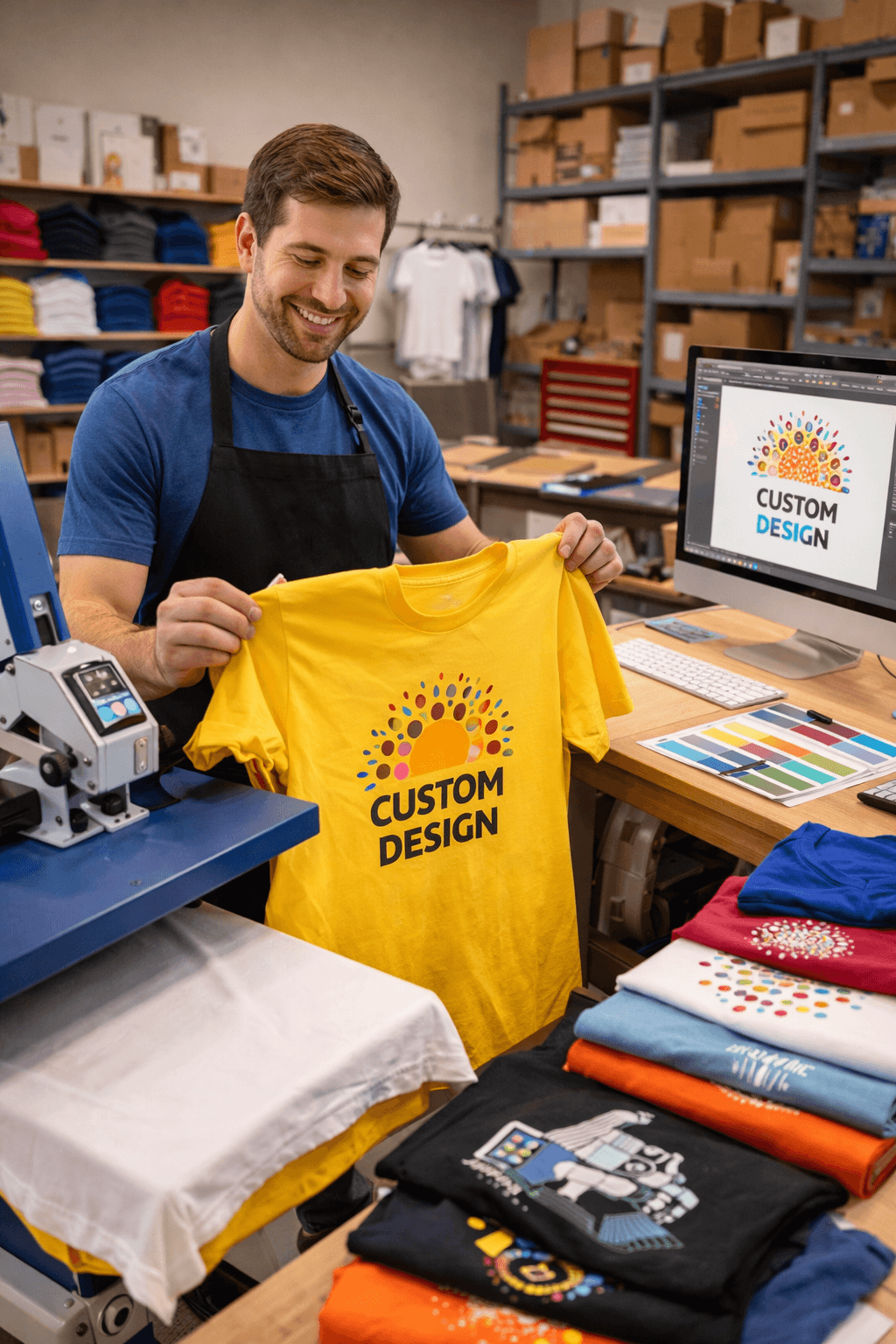
A custom t-shirt printing workspace with printed shirts, screen printing equipment, heat press tools, and neatly arranged apparel blanks

Quick Business Snapshot

Fast facts to help you grasp core traits quickly.

1

Startup Cost

Low to Medium

A small start is possible with heat transfer, DTG, or a simple outsourced production model, but costs rise quickly once you add in-house equipment, workspace, bulk blanks, and quality control.

Print-on-demand or outsourced production is a much lighter entry point than running a real print shop from day one.

2

Skill Barrier

Medium to High

You do not need to be a fashion designer, but you do need design judgment, print-process awareness, apparel sourcing discipline, and enough production knowledge to avoid disappointing customers.

Customers are buying both the design and the quality of the finished shirt.

3

Time to First Revenue

Fast to Moderate

A first sale can happen quickly through ecommerce, local team and event orders, or creator-driven demand, but building stable repeat sales usually takes longer.

The first shirt sale is easier than building a repeatable order engine.

4

Repeat Potential

Medium

Repeat demand can come from businesses, schools, events, teams, creators, and brands, but many customer orders are still campaign-based or occasion-based rather than weekly habits.

The strongest repeat pattern usually comes from accounts and communities, not random one-off buyers.

5

Local Dependency

Low to Medium

This can be built locally through schools, teams, and businesses, or remotely through ecommerce and online custom ordering.

It is less local than service businesses, but still very dependent on finding a reliable customer lane.

6

Scalability

Medium

It can grow through ecommerce, B2B accounts, creator merchandise, and better production systems, but scaling increases fulfillment pressure, quality control, and return risk.

Growth usually comes from stronger systems and channels, not just from adding more designs.

7

Competition

Very High

You compete with local print shops, online custom printers, Etsy sellers, POD platforms, streetwear brands, and large corporate merch providers.

The market is not short on printed shirts. It is short on strong positioning and reliable execution.

8

Operational Intensity

Medium to High

Printing methods, sizing issues, blank sourcing, turnaround promises, and order management make this more operationally demanding than it first appears.

A simple-looking shirt business can still become a real production workflow.

Market & Demand Signals

This section helps show where demand usually comes from and what signals are worth noticing.

Demand Type

Custom identity products + branded merchandise + event apparel + creator and small-business demand

Customer Pattern

Small businesses, teams, schools, creators, event organizers, communities, and direct online buyers

Service Format

Custom order printing + branded merch + ecommerce apparel sales + local bulk runs

Market

This is a real growth category, not just a hobby seller niche

The custom t-shirt printing market continues to expand because personalized apparel, creator merchandise, and branded small-batch products have become normal buying behavior rather than niche demand. That supports both a T-Shirt Printing Business and a more focused custom apparel business.

The category is growing, but growth does not remove the need for sharp positioning and reliable delivery.

Printing Base

The business sits inside a broader apparel-printing and custom screen-printing industry

Apparel printing such as T-shirts, caps, jackets, and similar textile products is part of a recognized U.S. screen-printing and custom-printing industry rather than an informal side trade.

The business is real, but it behaves more like competitive custom production than like easy passive ecommerce.

Digital Shift

Digital and online custom printing are making entry easier, but also making competition broader

Digital printing and online original-design shirt sales have lowered the barrier to starting, which helps small operators enter but also increases the number of sellers competing for attention. It is easier than before to launch custom T-shirts or custom apparel printing, but that also means positioning matters more.

Lower barriers help you start, but they also help many others start.

Labor

This is a creative product business, but the wage floor is still fairly practical

Running in-house production still depends on ordinary production labor economics, not only on design talent or brand storytelling.

The business can feel artistic, but production still runs on practical operating labor.

Quick Reality Check

Before you take this idea seriously, check these real-world signals first.

01

Are you building a custom print service, a merch brand, or a production shop for other people?

Those can overlap, but they behave very differently in marketing, margins, and repeat demand.

A narrower lane usually makes pricing, equipment choices, and customer acquisition much easier. A custom T-Shirt business, a custom apparel printing service, and a broader apparel business should not be sold as if they were all the same offer.

02

Do you understand the difference between selling designs and running production?

A shirt can look simple online, but the real business may involve blanks, print quality, packaging, order accuracy, and customer complaints.

You need to know whether your edge is design, local account access, or production reliability.

03

Can you compete in a category where entry is easy but differentiation is hard?

Many sellers can print shirts. Fewer can create a clear reason to buy from them specifically.

A strong niche or customer type usually matters more than offering generic custom shirts.

04

Can you manage quality expectations around something customers physically wear?

Fabric feel, print durability, sizing, color accuracy, and shipping speed all shape whether the customer feels satisfied.

A nice mockup is not the same thing as a good finished product.

What People Often Underestimate

Parts of this idea may look simple at first but become heavy in daily delivery.

Quality Gap

The hardest part is often not selling the shirt, but making the shirt feel good enough to keep the customer

Blanks, print placement, wash durability, and sizing consistency all affect repeat trust.

Commodity Pressure

Printed shirts can become price-sensitive very quickly

If the offer feels generic, buyers compare you against cheaper local printers, POD sites, and bulk merch suppliers.

Production Friction

Order complexity can rise faster than beginners expect

Color counts, rush orders, size splits, design revisions, and fulfillment mistakes can quietly turn a simple product into a demanding workflow.

Startup Cost

What you may need to spend before this idea becomes real.

Cost Pressure

Low to Medium

Testability

Easy to test small

Cost Structure

Blanks + printing method + design + packaging + shipping + software or equipment

Lean Start

The lightest workable version usually begins with outsourced or low-equipment production

Print-on-demand, local contract printing, or a simple heat-press setup can reduce early risk compared with opening a full in-house screen-printing shop immediately. That is often the most practical way to test a custom T-Shirt business before building a larger custom printing business.

A lighter production model usually makes the first stage much easier to test.

Equipment Cost

The visible startup cost depends heavily on the production method you choose

Screen printing, DTG, DTF, heat transfer, and outsourced fulfillment all have very different equipment, labor, and margin profiles.

Choosing the wrong method too early can create unnecessary complexity.

Ongoing Cost

Recurring costs usually come from blanks, fulfillment, and mistakes

Shirt quality, reprints, shipping, packaging, rush work, and unsold designs often shape profit more than the first equipment purchase.

A shirt business can look light until returns and rework start eating margin.

What This Idea Really Asks of You

Done matters more than perfect in early stage execution.

T-shirt printing can become a strong custom product business, but it asks you to combine positioning, production discipline, and customer trust rather than simply upload designs and hope for sales.
1

You need to accept that this is not only a design business

Customers may come for the artwork, but they stay or leave based on fabric feel, print quality, fit, and delivery experience.

The design attracts attention. The finished product decides the business.

2

You need to build a clear customer lane before chasing volume

Schools, small brands, event organizers, churches, teams, creators, and niche communities all buy shirts differently.

A sharper lane usually matters more than offering every type of custom shirt.

3

You need to compress custom work into something repeatable

If every order feels like solving a new production puzzle, growth becomes stressful and margins stay fragile.

Templates, standard options, and process discipline are often worth more than endless flexibility.

4

You need to treat quality control as part of brand trust

Misprints, weak blanks, crooked placement, and poor wash performance damage credibility much faster in apparel than in many digital businesses.

A lot of the business is won or lost after the customer opens the package.

How This Idea Usually Grows

Many ideas do not start at scale; they stabilize first.

1

Move from first orders to repeat accounts or repeat communities

Early growth usually comes from becoming the dependable option for a specific group of customers rather than trying to serve the whole internet at once.

Reminder: Stable repeat demand usually comes before healthy scale.

2

Move from generic shirt selling to clearer service or brand positioning

Creator merch, school apparel, local business uniforms, event shirts, niche streetwear, or premium blanks all create much clearer buying logic than broad generic printing. The clearer the lane, the easier it is to stand out in custom T-shirts and custom apparel.

Reminder: Clarity usually makes pricing and marketing easier.

3

Move from founder-driven order handling to systems and production discipline

As demand grows, the next layer usually comes from stronger quoting, standardized print methods, better fulfillment workflows, and cleaner quality control.

Reminder: More orders without better systems usually creates rework, not growth.

AI / Automation Angle

Where AI can assist and where human delivery still matters.

Can Be Assisted

Design ideation, listing copy, mockups, customer communication, and order workflow support

Still Needs Human

Final design judgment, print quality control, material decisions, and customer trust

Overall Role

An efficiency layer around creative and operational work

Creative

AI can speed up the first layer of design and product ideation

Concept exploration, slogan variations, collection themes, and mockup copy can be created faster when testing shirt ideas or customer directions.

It helps with speed, but it does not replace taste or print-ready judgment.

Admin

AI can reduce repetitive product and customer work

Product descriptions, quote drafts, care instructions, order confirmations, and bulk-order explanations can be prepared faster through structured templates.

It saves admin time, but it does not replace real production accuracy.

Operations

AI becomes more useful once the workflow is already defined

Order summaries, size-breakdown notes, reprint tracking, and recurring account patterns can be organized more consistently over time.

The more repeatable the workflow becomes, the more useful this support gets.

Sources & Verification

This page combines public market research, industry classification context, labor-market data, printing-safety context, and editorial judgment. Custom t-shirt market growth mainly draws from Grand View Research; apparel-printing industry context mainly draws from IBISWorld coverage of custom screen printing and related classifications; wage context mainly draws from the U.S. Bureau of Labor Statistics; printing workplace safety context mainly draws from OSHA printing-industry guidance. The goal is to judge whether a T-Shirt Printing Business, custom T-Shirt business, or broader custom apparel printing offer can be run profitably.

Data Sources

Market research + industry classification + labor and safety sources

Case Inputs

Custom printing patterns + ecommerce and production observations

Nature of Judgment

Editorial synthesis, not a single-source quotation

market size

Grand View Research

Supports: Custom t-shirt printing market size and growth

Key point: The global custom t-shirt printing market was valued at about $5.16 billion in 2024 and is projected to reach about $9.82 billion by 2030.

View source →
printing method context

Grand View Research

Supports: Growth of digital printing and the continued importance of screen printing

Key point: Screen printing remained the largest technique segment, while digital printing was the fastest-growing technique segment.

View source →
us market context

Grand View Research

Supports: U.S. market size and growth outlook

Key point: The U.S. custom t-shirt printing market was valued at about $857.5 million in 2023 and is projected to keep growing strongly through 2030.

View source →
industry context

IBISWorld

Supports: Custom screen printing as a real U.S. operating category

Key point: IBISWorld maintains dedicated U.S. coverage for the Custom Screen Printing industry.

View source →
business count

IBISWorld

Supports: Scale of U.S. custom screen printing businesses

Key point: There were about 15,427 custom screen printing businesses in the U.S. in 2025.

View source →
apparel printing definition

IBISWorld

Supports: Placement of T-shirt and apparel printing within commercial screen printing

Key point: Industry classification context explicitly includes printing on apparel and textile products such as T-shirts, caps, jackets, towels, and similar items.

View source →
online sales context

IBISWorld

Supports: Growth context for online original design T-shirt sales

Key point: IBISWorld tracks strong growth in the U.S. online original design T-shirt sales category.

View source →
wage context

BLS

Supports: Production labor wage context for in-house printing operations

Key point: Printing press operators had a median annual wage of about $41,860 in 2023.

View source →
safety context

OSHA

Supports: General workplace-safety reality in printing operations

Key point: OSHA highlights chemical exposure, fire, machine, ventilation, and musculoskeletal risks in printing-industry operations.

View source →
The parts of this page covering market growth, screen-printing industry context, apparel-printing classification, online sales growth, wage context, and printing-safety concerns are grounded in public sources. The parts covering niche strategy, quality-control pressure, commodity pricing, repeat-account logic, and growth structure are editorial conclusions built from those sources rather than direct single-source claims.
T-shirt printing can be a real business, but it becomes much stronger when you know whether you are selling custom service, branded merch, or niche apparel. To judge whether it is worth doing, you still need to look at your customer lane, print method, blank quality, turnaround expectations, and whether your offer gives buyers a reason to choose you instead of a cheaper or faster competitor. That is true whether you frame it as custom T-shirts, custom apparel printing, or a wider apparel business.

Keep exploring at your own pace

You do not need to decide now. Save it, note it, and compare more ideas.

Explore more ideas

Share this idea