Vending Machine Business

A location-based retail business built on machine placement, inventory turnover, route efficiency, and low-touch recurring sales. A vending machine business is one of the clearest small-scale forms of automated retail business or unattended retail business, but it still depends on location quality and operating discipline.

Local ServiceLocal ServiceRepeat Demand

This page is here to help you see the structure of the business, not make the decision for you. Vending sounds passive because it is unattended retail, but a real vending machine business still runs on location access, refill discipline, machine uptime, and route control.

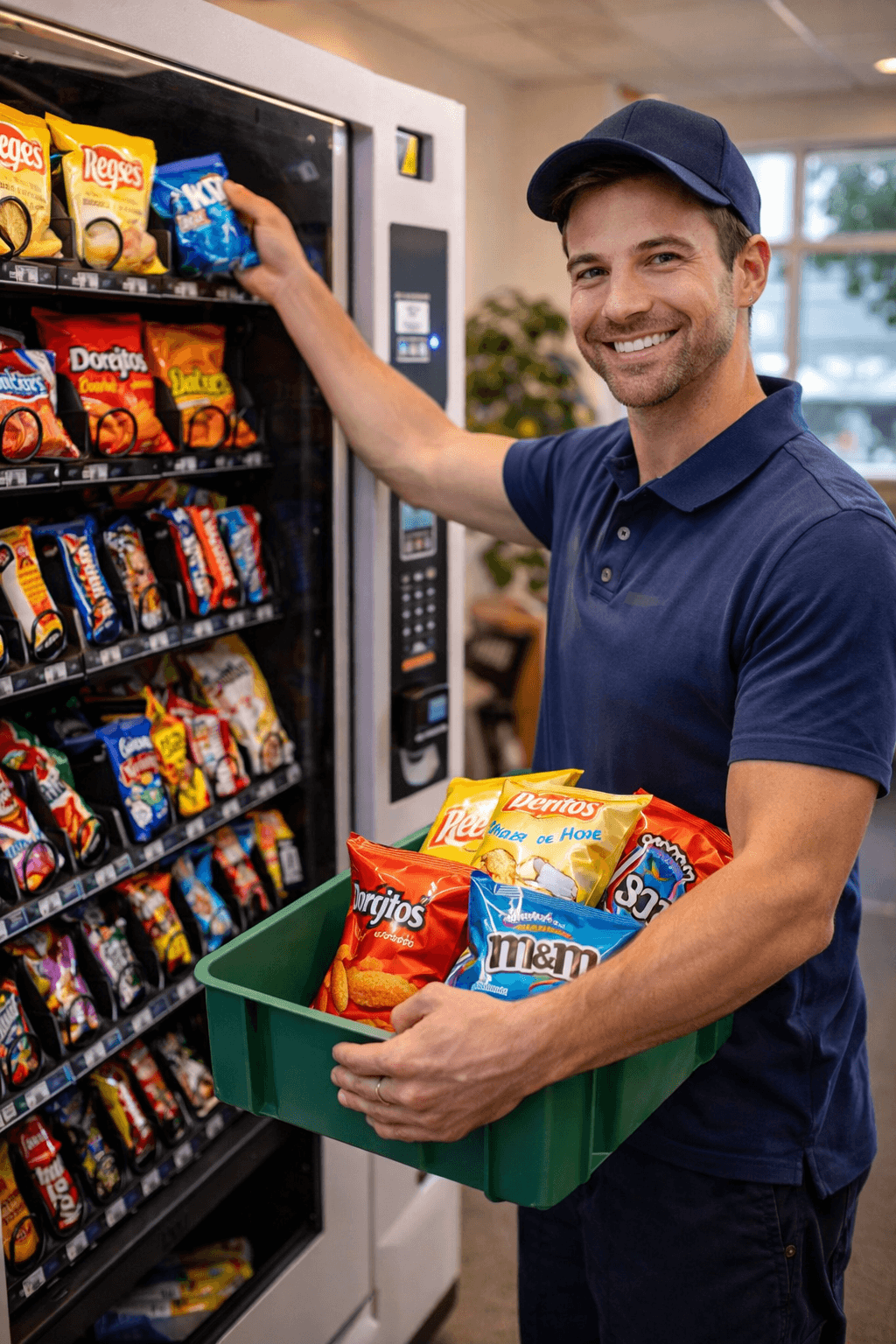
A row of modern vending machines stocked with drinks and snacks in a busy office

Quick Business Snapshot

Fast facts to help you grasp core traits quickly.

1

Startup Cost

Low to Medium

A small start is possible with one used machine and one location, but costs rise once you add payment systems, repairs, transport, and multiple placements.

It looks passive from the outside, but machine setup and location access still require real capital.

2

Skill Barrier

Medium

You do not need advanced technical skill to begin, but product selection, route planning, machine upkeep, and location management matter more than beginners expect.

This is less about retail selling face to face and more about quiet operational discipline.

3

Time to First Revenue

Moderate

A machine can start generating sales quickly once placed in a good location, but finding and securing that location is often the slower part.

The machine can earn fast. Getting the right placement is harder.

4

Repeat Potential

High

Once a machine is placed well, sales can repeat daily through routine foot traffic without needing fresh customer acquisition each time.

The repeat pattern comes from the location, not from brand loyalty alone.

5

Local Dependency

High

Foot traffic, property access, refill distance, and route density make this much more local than it first appears.

A good machine in a weak location is still a weak business.

6

Scalability

Medium

It can scale through more machines and tighter routes, but each added machine increases restocking, maintenance, and cash-flow complexity.

Growth usually comes through disciplined expansion, not just buying more machines.

7

Competition

Medium to High

You compete with convenience stores, breakroom providers, cafeterias, and other operators chasing the same high-traffic locations.

The strongest competition is often for placement, not for the snack itself.

8

Operational Intensity

Medium

The work is lighter than many field-service businesses, but stockouts, machine failures, card-reader issues, and poor route planning still hurt quickly.

It becomes passive only after the system is already working.

Market & Demand Signals

This section helps show where demand usually comes from and what signals are worth noticing.

Demand Type

Impulse convenience + unattended retail + workplace and public-traffic consumption

Customer Pattern

Offices, schools, hospitals, industrial sites, transit areas, and other steady-foot-traffic locations

Service Format

Snack and beverage machines + specialty machines + route-based restocking and service

Market

This is a real operating category, but not one you can win through momentum alone

The U.S. vending machine operators industry is estimated at about $7.7 billion in 2025. That confirms real demand, but the category has been broadly flat to slightly declining over recent years. A vending machine business is still a real convenience services business, but not one lifted automatically by market growth.

The business is proven, but growth usually comes from better placements and tighter operation rather than from a rising market lifting everyone.

Scale

The channel is still physically large even when growth is not dramatic

Industry reporting estimated about 2.3 million vending machines in U.S. locations in 2024, which shows unattended retail remains a meaningful distribution channel. That is the strongest case for framing this as an automated retail business rather than just a passive-income idea.

This is not a tiny niche. The harder question is whether you can access the right locations.

Location

Placement quality matters more than most beginners think

Operators compete heavily for offices, manufacturing sites, schools, medical facilities, and other repeat-traffic locations because the machine's earning power depends heavily on usage concentration.

A mediocre machine in a strong location usually beats a great machine in a weak one.

Regulation

Food vending is simple to understand, but not regulation-free

Federal calorie-labeling rules apply to certain operators with 20 or more vending machines, and food-safety expectations can also be shaped by federal, state, and local rules depending on product type and jurisdiction.

You may be testing small, but compliance gets heavier as the operation grows.
Quick Reality Check

Before you take this idea seriously, check these real-world signals first.

01

Can you get access to strong locations, not just buy a machine?

The machine itself is usually easier to acquire than a profitable placement.

A vending business is often won at the location-negotiation stage, not at the equipment stage. That is true in a snack vending machine business as much as in any larger unattended retail business.

02

Can you handle route work and maintenance without pretending the business is passive?

Machines need stocking, cleaning, repairs, payment checks, and customer support when things go wrong.

This becomes low-touch only after placements, products, and route rhythm are already stable.

03

Do you understand how margin gets eaten quietly?

Commissions, spoilage, card-processing costs, fuel, shrinkage, and machine downtime can all reduce the appeal of simple-looking sales numbers.

Gross sales are not the same thing as healthy unit economics.

04

Do you know whether you want snack-and-beverage volume, or a more specialized niche?

General snack vending, healthy vending, beverage-heavy locations, and specialty machines are related, but they do not all behave like the same business.

A narrower operating model often makes purchasing and route decisions much easier.

What People Often Underestimate

Parts of this idea may look simple at first but become heavy in daily delivery.

Placement Risk

The quality of the location usually matters more than the quality of the machine

A machine can look fully operational and still perform poorly if traffic is weak or buyer intent is low.

Refill Economics

A business with repeat sales can still suffer from bad route economics

Long refill drives, scattered machines, and frequent low-volume stops quietly weaken margin.

Maintenance Friction

Small machine problems create outsized business problems

A jammed coil, dead card reader, or refrigeration issue can immediately stop revenue at that location.

Startup Cost

What you may need to spend before this idea becomes real.

Cost Pressure

Low to Medium

Testability

Possible to test small

Cost Structure

Machine + inventory + payment system + transport + repairs + commissions

Lean Start

The earliest workable version usually starts with one machine and one good location

A used machine, a simple snack or beverage mix, and a nearby location can keep the first test much lighter than jumping into a full route immediately. That is usually the most practical answer to how to start a vending machine business without overcommitting capital.

The smartest first step is often proving location quality before expanding hardware.

Machine Cost

The visible cost is the machine, but the hidden cost is keeping it productive

Card readers, repairs, inventory, commissions, and service visits often matter just as much as the original purchase price.

A cheap machine can become an expensive machine if reliability is poor.

Ongoing Cost

Recurring operating friction usually shapes the real profit

Product cost, restocking time, payment issues, spoilage, fuel, and route inefficiency all keep affecting margin after launch.

The business often wins through quiet operational discipline rather than big-ticket moves.

What This Idea Really Asks of You

Done matters more than perfect in early stage execution.

A vending machine business can become a practical semi-automated retail model, but it asks you to manage locations, restocking, maintenance, and route economics rather than chase the fantasy of easy passive income. In other words, it is automated retail, not effortless retail.
1

You need to accept that location quality is the core asset

The same machine can be weak in one building and strong in another because customer flow and buying context drive most of the revenue.

The machine matters, but the placement usually matters more.

2

You need to build route efficiency before chasing machine count

A scattered group of low-volume machines can create more work than profit, even when each one technically makes sales.

Density often matters more than size at the beginning.

3

You need to treat upkeep as part of the product

A clean, working, well-stocked machine earns differently from one that is half-empty, malfunctioning, or badly merchandised.

In unattended retail, maintenance is part of customer trust.

4

You need to stay realistic about margins and commissions

Location commissions, card fees, inventory loss, and machine downtime can quietly make a seemingly simple model much less attractive.

Small-ticket retail becomes fragile when too many small costs stack together.

How This Idea Usually Grows

Many ideas do not start at scale; they stabilize first.

1

Move from one machine to a small cluster of strong placements

Early growth usually comes from proving a few productive locations in a tight area rather than buying many machines too quickly.

Reminder: A tight route usually comes before healthy scaling.

2

Move from generic stocking to location-specific product logic

Different locations respond to different products, price points, and package sizes, so growth usually improves when the inventory mix becomes more deliberate.

Reminder: The best product mix is usually discovered at the location level, not guessed globally.

3

Move from solo servicing to systems and monitoring

As the business grows, the next layer usually comes from route planning, restock tracking, cashless payment data, maintenance discipline, and clearer service standards.

Reminder: More machines without better systems usually creates mess, not scale.

AI / Automation Angle

Where AI can assist and where human delivery still matters.

Can Be Assisted

Route planning, inventory tracking, pricing notes, restock reminders, and simple outreach

Still Needs Human

Location negotiation, machine servicing, product judgment, and on-the-ground operations

Overall Role

An efficiency layer around unattended retail management

Admin

AI can reduce repetitive outreach and tracking work

Location pitch drafts, refill logs, service notes, and simple commission communication can be organized faster through templates.

It reduces admin friction, but it does not replace field execution.

Operations

AI can help make stocking and route decisions more consistent

Sales notes, stockout patterns, restock timing, and low-performing SKUs can be summarized more clearly over time.

The more repeatable the route becomes, the more useful this support gets.

Marketing

AI can help test clearer placement proposals and niche positioning

Healthy-vending pitches, workplace convenience messaging, and simple proposal copy can be created faster when approaching property managers or site owners.

That helps with outreach, but strong placements still depend on real negotiation and proof.

Sources & Verification

This page combines public industry data, convenience-services research, labor context, and federal vending-machine rules, along with editorial judgment. U.S. vending machine industry size mainly draws from IBISWorld; broader convenience-services and machine-count context mainly draw from NAMA and VendingMarketWatch's State of the Vending Industry; wage context mainly draws from the BLS; vending-machine calorie-labeling context mainly draws from the FDA. The goal is to judge whether a vending machine business, snack vending machine business, or small unattended retail business can actually work in a given local route.

Data Sources

Public market data + industry association + labor and regulatory sources

Case Inputs

Route-based vending patterns + location and machine-operating observations

Nature of Judgment

Editorial synthesis, not a single-source quotation

industry size

IBISWorld

Supports: U.S. vending machine operators industry size and general growth context

Key point: The U.S. vending machine operators industry is about $7.7 billion in 2025 and has been broadly flat to slightly declining over recent years.

View source →
business count

IBISWorld

Supports: U.S. vending machine operator business count

Key point: There were about 16,229 vending machine operator businesses in the U.S. in 2024.

View source →
industry context

NAMA Census

Supports: Broader convenience-services industry scale and vending's share

Key point: NAMA estimated 2023 vending revenue at about $18.2 billion within the broader U.S. convenience services industry.

View source →
machine count

VendingMarketWatch State of the Vending Industry

Supports: Estimated vending machine count and placement context

Key point: Operators had an estimated 2.3 million vending machines in locations in 2024.

View source →
route labor context

BLS Occupational Outlook Handbook

Supports: Driver and route-service wage context

Key point: Driver/sales workers had a median annual wage of about $37,130 in May 2024.

View source →
labeling context

FDA

Supports: Federal calorie-labeling rules for larger vending operators

Key point: Operators who own or operate 20 or more vending machines are subject to federal calorie-disclosure requirements for covered foods, subject to certain exemptions.

View source →
The parts of this page covering U.S. industry size, business count, broader vending context, machine counts, wage context, and federal labeling rules are grounded in public sources. The parts covering placement quality, route-density logic, commission pressure, machine-failure risk, product-mix decisions, and growth structure are editorial conclusions built from those sources rather than direct single-source claims.
This business is often described as passive, but that description is incomplete. To judge whether it is worth doing, you still need to look at location access, expected foot traffic, commission demands, refill distance, payment-system reliability, and whether your local route can become dense enough to support the work. The real question behind a vending machine business plan or how to start a vending machine business is not just whether the machine works - it is whether the placement and route economics work.

Keep exploring at your own pace

You do not need to decide now. Save it, note it, and compare more ideas.

Explore more ideas

Share this idea