1
Startup Cost
Low to Medium
It is easy to start small, but real costs rise once bees, gear, feed, treatments, and harvesting tools are counted.
Read As
Easy to start does not mean easy to make profitable.
A small agricultural business built on colony health, seasonal production, local sales, and sometimes pollination income. Beekeeping can look simple from the outside, but the real business depends on whether you can keep colonies alive, build stable channels, and turn a biological cycle into something commercially repeatable.
This page is here to help you see the structure of the business, not make the decision for you.
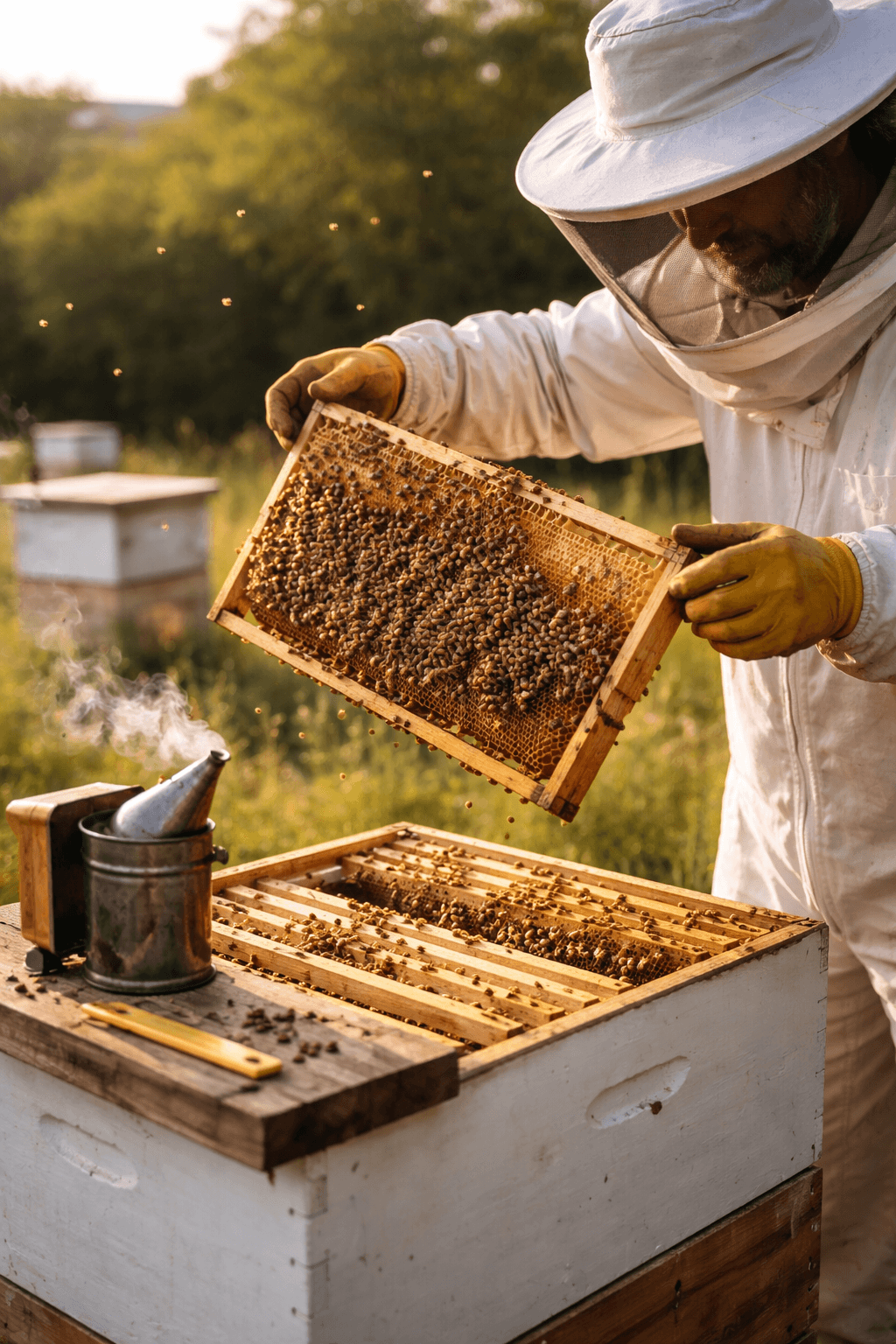
Fast facts to help you grasp core traits quickly.
Startup Cost
It is easy to start small, but real costs rise once bees, gear, feed, treatments, and harvesting tools are counted.
Read As
Easy to start does not mean easy to make profitable.
Skill Barrier
This is colony management, not just honey collection.
Read As
A beekeeper is closer to a livestock operator than a simple product seller.
Time to First Revenue
You can sell small amounts early in some cases, but meaningful output usually takes time.
Read As
The first season often teaches more than it pays.
Repeat Potential
Repeat demand can come from local honey buyers, markets, retailers, and pollination clients.
Read As
Supply consistency matters more than a one-time good harvest.
Local Dependency
Forage, climate, pesticide exposure, and local rules shape the business heavily.
Read As
This is an environment business as much as a product business.
Scalability
More hives can grow output, but they also multiply biological risk and management pressure.
Read As
More boxes do not remove colony problems.
Competition
Local sellers are only part of the competition. Cheap imported honey matters too.
Read As
Local trust helps, but it does not erase commodity pressure.
Operational Intensity
Inspections, swarm control, mite treatment, harvest, extraction, and overwintering create a real operating cycle.
Read As
The jar is only the visible end of the work.
This section helps show where demand usually comes from and what signals are worth noticing.
Demand Type
Customer Pattern
Service Format
The global apiculture market was estimated at about $9.31 billion in 2024, while the global honey market was about $9.01 billion in 2022 with further growth projected through 2030. That matters because one of the first questions beginners ask is what is the beekeeping business in commercial terms. The answer is broader than honey jars alone.
A stronger beekeeping business usually makes more sense when you stop seeing it as only jars of honey.
U.S. honey production fell 14% in 2025 to 116 million pounds, while the average price rose 27% to $3.05 per pound. That shows how production stress and pricing can move in opposite directions. For anyone trying to understand how to start beekeeping as a business, this is an important reality: better prices do not automatically make the operating work easier.
Higher prices do not automatically mean an easier year for beekeepers.
USDA reported more than $400 million in pollination services in 2024, and the 2025 average almond pollination price rose to $209 per colony. That is one reason the commercial answer to what is the beekeeping business goes beyond bottled honey and includes pollination income, nucleus colonies, queens, and other apiary outputs.
If you only think in honey jars, you may be looking at the business too narrowly.
IBISWorld estimates U.S. beekeeping industry revenue at about $640.2 million in 2025 and says imports account for over 60% of domestic demand.
That is why small operators usually need local positioning, not commodity pricing.
The 2024-2025 U.S. Beekeeping Survey estimated 55.6% annual managed-colony losses, and USDA continued to identify varroa mites as the top reported colony stressor. That is why how to become a beekeeper for business purposes is not mainly a branding question. It is a colony-management question first.
The business gets much harder if the hive-health side is treated casually.
Before you take this idea seriously, check these real-world signals first.
The work includes loss, disease pressure, replacement, and seasonal judgment.
Check: Liking honey is not the same as liking beekeeping. This is often the first hard truth behind how to become a beekeeper in commercial terms.
Forage, water, neighbors, pesticide exposure, and local registration rules matter more than many beginners expect.
Check: A weak site quietly makes the whole model worse, even if the gear side of how to start beekeeping feels manageable.
A lot of people can produce some honey. Fewer can sell it in a repeatable way at a good margin.
Check: Choose early whether you are aiming for direct retail, wholesale, pollination, breeding, or a mixed model. How to start beekeeping as a hobby and how to start beekeeping as a business are not the same question.
This is not a business where each hour worked quickly turns into revenue.
Check: A weak season can delay income even when the labor was real, which is why beekeeping can feel slower than beginners expect.
Parts of this idea may look simple at first but become heavy in daily delivery.
A hive is not a one-time setup that quietly produces forever. This is one reason the commercial side of beekeeping is heavier than hobby-first beginners often expect.
Small starts can be educational long before they feel financially meaningful, even when the equipment side of how to start beekeeping looked straightforward.
Extraction, bottling, labeling, cleanup, and sales all begin after the hive work.
A beekeeping starter kit or one of the many beginning beekeeping kits for sale can reduce early friction, but gear does not remove the need for site quality, colony survival skill, and a real sales channel.
What you may need to spend before this idea becomes real.
Cost Pressure
Medium
Testability
Easy to test small
Cost Structure
Hives + bees + protective gear + feed + treatments + harvest tools
Mississippi State Extension estimated about $1,070.34 to establish one hive, plus about $324.98 for sample harvesting equipment. That makes beekeeping easier to test than many farm ideas, and it explains why beginners often start by shopping for a beekeeping starter kit or looking at beginning beekeeping kits for sale.
Cheap to test is not the same as easy to prove profitable.
Missouri Extension notes that going from initial establishment to 10 hives can take three to five years with normal growth. That is an important corrective for people learning how to start beekeeping who assume more boxes can be added quickly without much biological risk.
The business usually becomes clearer over multiple seasons, not in one quick cycle.
Feed, mite treatments, packaging, winter prep, and colony replacement keep affecting the business after startup. That is why beekeeping often lands closer to medium startup pressure than the kit-first marketing angle suggests.
A low entry point does not mean a light operating cycle.
Done matters more than perfect in early stage execution.
Management helps, but weather, forage, pests, and seasonal conditions still set limits. That is one of the first realities behind how to become a beekeeper in a serious way.
Reminder: This is a management business, not a total-control business.
The healthier version of the business usually comes from repeat buyers, market routines, or pollination contracts. Beekeeping gets more durable when there is already a sales channel waiting before the strong harvest arrives.
Reminder: Good years feel better when there is already a sales channel waiting.
Pollination, beeswax, nucs, queens, and direct local branding can make the model more resilient. That broader view usually separates hobby beekeeping from commercial beekeeping.
Reminder: A single revenue lane makes a biological business more fragile.
Weak hives quietly damage production, pollination value, overwintering, and the next season's starting point. In beekeeping, most commercial problems show up in the jar later, but they begin in the hive earlier.
Reminder: Most problems show up in the jar later, but they begin in the hive earlier.
Many ideas do not start at scale; they stabilize first.
Early progress usually comes from learning how to keep colonies healthy through a full seasonal cycle. That is why how to start beekeeping and how to grow beekeeping are really two different stages.
Reminder: Survival skill comes before scale.
Once output is more dependable, growth usually comes from direct sales, repeat local buyers, or small retail accounts. Beekeeping becomes more business-like when the sales side is no longer improvised every harvest.
Reminder: The easier it is to sell repeatedly, the easier it is to grow.
As the operation matures, stronger economics often come from pollination, nucleus colonies, queens, better overwintering, and cleaner systems. This is usually the stage where beekeeping becomes a more complete apiary business rather than a single-product side hustle.
Reminder: Bigger apiaries usually survive through structure, not optimism.
Where AI can assist and where human delivery still matters.
Recordkeeping, labeling, customer education, sales copy, and seasonal task reminders
Hive inspections, disease judgment, extraction, local sales, and live colony management
An efficiency layer around the business
Inspection logs, inventory notes, labels, product descriptions, and customer replies can be handled more consistently. That helps beekeeping operators who are good in the yard but weaker on the desk side.
It saves desk time, but it does not manage the bees.
FAQs about raw honey, floral sources, storage, crystallization, and pickup details can be explained more clearly without rewriting everything by hand. That matters most when beekeeping revenue depends on direct local sales.
That matters most when you sell direct.
Treatment schedules, equipment lists, harvest prep, packaging checklists, and market-day routines can be turned into cleaner systems. That is more useful after you already understand how to start beekeeping and need help running the season more cleanly.
The more hives you manage, the more useful this support layer becomes.
This page combines public market data on apiculture and honey, USDA production and pollination data, colony-health signals, U.S. beekeeping industry structure data, and extension startup-cost budgets. Because beekeeping can mean hobby honey, direct retail honey, pollination, nuc sales, queens, wax, or a mixed apiary model, the page also uses editorial judgment to connect the numbers to a practical small-business version of the idea. Search intent here often starts with questions like how to start beekeeping, how to become a beekeeper, or what is the beekeeping business in real commercial terms.
Data Sources
Public market data + USDA production and pollination data + extension budgets
Case Inputs
Honey production + pollination economics + colony management pressure + beginner startup framing
Nature of Judgment
Editorial synthesis, not a single-source quotation
Supports: Overall commercial demand context for bee products and apiculture
Key point: The global apiculture market was estimated at about $9.31 billion in 2024 and is projected to reach about $11.78 billion by 2030.
View source →Supports: Global honey demand and growth context
Key point: The global honey market was valued at about $9.01 billion in 2022 and is projected to reach about $13.57 billion by 2030.
View source →Supports: U.S. honey production, colony count, price, and pollination income
Key point: U.S. honey production in 2025 totaled 116 million pounds, with 2.41 million honey-producing colonies, average honey prices of $3.05 per pound, and pollination income of $225 million.
View source →Supports: Commercial pollination pricing context
Key point: The average almond pollination cost rose from $181 per colony in 2024 to $209 per colony in 2025.
View source →Supports: Relative economic weight of pollination
Key point: U.S. producers spent more than $400 million on pollination services in 2024.
View source →Supports: Colony loss and stressor context
Key point: Operations with five or more colonies lost 267,260 colonies in January through March 2025, and varroa mites remained the top reported stressor.
View source →Supports: Recent annual colony loss pressure
Key point: The 2024-2025 U.S. Beekeeping Survey estimated 55.6% annual managed-colony losses, the highest annual loss rate reported since the survey began.
View source →Supports: U.S. beekeeping industry revenue and import pressure
Key point: IBISWorld estimates U.S. beekeeping industry revenue at about $640.2 million in 2025 and says imports account for over 60% of domestic demand.
View source →Supports: Recent small-scale startup cost benchmark
Key point: A 2025 extension budget estimated about $1,070.34 to establish one hive, plus about $324.98 for sample honey-harvesting equipment.
View source →Supports: Timeline and planning context for scaling
Key point: Missouri Extension notes that moving from initial establishment to 10 hives can take three to five years with normal growth.
View source →Explore nearby directions with different workload and demand shape.

An artisan bakery looks warm and simple from the customer side, but the real business runs on timing, consistency, waste control, and whether enough people decide that your version is worth making part of their routine.
Explore idea →
A practical local service business built on hygiene, stain removal, odor control, and repeat maintenance. The real carpet cleaning business is not just cleaning carpet - it is becoming the company customers trust when pets, kids, traffic, and time make the home or office feel dirty again. The stronger carpet cleaning business usually wins on results, drying time, and reliability rather than cheap coupons alone.
Explore idea →
A seasonal home-service business built on safety, inspections, and trusted maintenance for homes with fireplaces, stoves, and venting systems. The real chimney sweep business is not just soot removal - it is becoming the chimney cleaning service homeowners trust when fire safety, draft performance, and annual maintenance all matter at once.
Explore idea →You do not need to decide now. Save it, note it, and compare more ideas.