1
Startup Cost
Medium
A local pet taxi service can start relatively lean with a safe vehicle, restraints or crates, insurance, simple booking tools, and local marketing.
Read As
The vehicle matters, but the real product is trust plus process.
A trust-heavy service business built around convenience, timing, and low-error execution. The customer is not paying only for movement; they are paying for safe handoff, reliable arrival, and enough communication to stay calm while their pet is not with them. That is why pet transport services, pet relocation services, and higher-touch pet shipping business models all depend on process more than hype.
This page helps you see the real structure of a pet transportation services business: one part local route service, one part trust operation, and in some cases a much harder compliance-heavy relocation business. A real pet transport business can look simple from the outside, but pet transport services and pet relocation services split into very different operating models once paperwork, timing, and handoff risk show up.
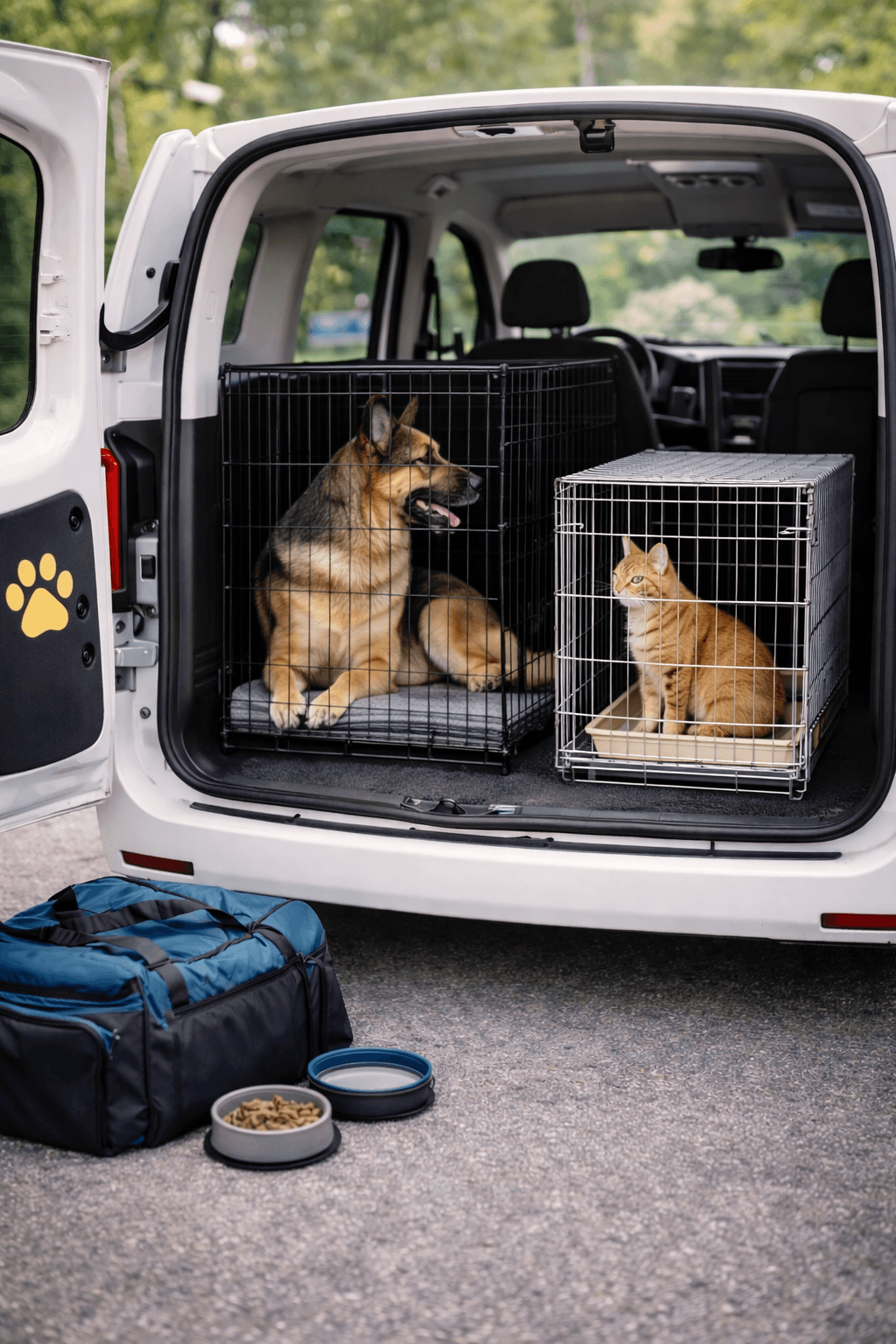
Fast facts to help you grasp core traits quickly.
Startup Cost
A local pet taxi service can start relatively lean with a safe vehicle, restraints or crates, insurance, simple booking tools, and local marketing.
Read As
The vehicle matters, but the real product is trust plus process.
Skill Barrier
You need calm animal handling, schedule discipline, route awareness, and strong client communication. The harder version of the business also requires documentation accuracy and travel-rule awareness.
Read As
This is part pet care, part logistics, and part reassurance.
Time to First Revenue
Local pet taxi services can get early bookings through vets, groomers, daycare partners, rescues, or neighborhood demand. Higher-ticket relocation work usually takes longer to earn trust for.
Read As
Local errands usually sell faster than relocation.
Repeat Potential
Recurring demand exists when owners need regular runs to daycare, grooming, rehab, or veterinary appointments. Relocation work is higher ticket but far less repeatable.
Read As
Routine clients are usually more valuable than dramatic one-offs.
Local Dependency
The local version of the business depends heavily on route density, service radius, and relationship-based referrals.
Read As
A messy map usually hurts this business faster than weak branding.
Scalability
Growth usually comes from adding drivers, tightening service zones, or expanding into premium transport tiers after the core operation is stable.
Read As
This scales through operations, not through hype.
Competition
The field is fragmented. Some competitors are dedicated transport providers, while others bundle pet taxi work into daycare, boarding, concierge, or walking businesses.
Read As
You are often competing against bundled convenience, not just direct specialists.
Operational Intensity
Live-animal transport leaves little room for sloppy timing, poor communication, or weak handoff procedures.
Read As
The product is safe arrival plus peace of mind.
This section helps show where demand usually comes from and what signals are worth noticing.
Demand Type
Customer Pattern
Service Mode
APPA put U.S. spending on 'Other Services' at USD 13.0 billion in 2024 and projected USD 13.5 billion for 2025. That category includes transportation-adjacent pet services inside a wider paid-service habit. Pet transport services do not need to invent willingness to pay from scratch.
A pet transport business sits inside a service pool pet owners already spend in.
APPA reported 94 million U.S. households owning at least one pet. Europe reported 139 million pet-owning households and 299 million pets, while Australia reported 31.6 million pets across 73% of households.
This supports the demand pool. It does not guarantee easy conversion.
IBISWorld sizes U.S. pet transportation services at about USD 2.2 billion in 2026, with 22,134 businesses in 2025 and no company holding more than 5% market share. That fits a fragmented market where pet transport services, pet relocation services, and pet shipping business offers can all exist without one giant operator owning the category.
That usually means room for local operators, but not a giant easy market.
Grand View Research values the global pet travel services market at about USD 2.4 billion in 2024 and projects roughly USD 3.9 billion by 2030.
The opportunity is real, but local pet taxi and international relocation are still very different businesses.
Visible pricing references show local ground transport in the low hundreds, longer-distance ground transport in the several hundreds to low thousands, and international moves moving materially higher once paperwork and coordination enter the picture. That spread is one reason a pet shipping business feels very different from a simple local pickup-and-drop service.
Complexity expands pricing faster than distance alone.
Before you take this idea seriously, check these real-world signals first.
These are not the same operation. Local pet taxi services depend on dense scheduling and recurring demand. Longer-distance or international transport depends more on compliance and coordination.
Check: Pick one service lane first. Trying to sell both from day one usually creates weak positioning and messy systems. The strongest pet transport business usually chooses between local pet transport services and true pet relocation services before it expands.
The business can look profitable until you count empty return trips, pickup delays, waiting at appointments, and time spent calming anxious owners.
Check: Run your math on full door-to-door time, not just drive time.
Pet transportation often includes pickup instructions, access responsibility, medication notes, and time-sensitive handoffs.
Check: Ask whether your process signals reliability within the first minute of contact.
Local transport is operationally demanding. Interstate and international transport can become documentation-heavy very quickly.
Check: Be clear about what you are legally and operationally set up to handle before you market it.
Parts of this idea may look simple at first but become heavy in daily delivery.
Local pet taxi work is comparatively straightforward, but interstate and international moves can quickly turn into a documentation-heavy workflow involving vaccinations, tests, permits, and health certificates. That is where pet relocation services stop looking like errands and start looking like logistics.
They are handing over anxiety, routine, access, and accountability. That is why weak communication hurts harder here than in many other local services.
A missed vet pickup, a traffic-heavy day, or an airport timing problem can ripple into multiple upset clients very quickly.
Cleanliness, maintenance, climate control, and safe restraint options are not cosmetic details. They directly affect trust, safety, and margin.
What you may need to spend before this idea becomes real.
Cost Pressure
Moderate
Testability
High for local / Medium for relocation
Cost Structure
Vehicle + insurance + fuel + safety gear + admin or compliance + marketing
In pet transportation services, the vehicle is not only transport. It is part of the trust signal. Cleanliness, climate control, restraints, crate options, and calm loading procedures all shape how professional pet transport services feel to the owner.
This startup framing is editorial synthesis based on operator realities, not a single universal benchmark.
Short local rides are usually smaller-ticket convenience sales, while domestic transport, shared rides, premium one-to-one transport, flight nanny work, and relocation support can move much higher. That is the real price ladder between a local pet transport business and premium pet relocation services.
In this business, complexity changes pricing faster than mileage alone.
Booking confirmations, pickup windows, ETA updates, photo check-ins, and handoff records all become part of the service experience quickly.
A calm system often sells better than a louder brand.
Done matters more than perfect in early stage execution.
You need to think in routes, buffers, handoffs, and backup plans. Small delays can poison the whole day if you do not design around them.
Reminder: Calendar discipline is part of animal welfare here.
Some pets travel easily. Others panic, resist loading, get carsick, or shut down during unfamiliar transitions.
Reminder: Moving a pet safely is not the same as moving cargo.
Clients want confirmations, updates, ETA changes, and reassurance. In pet taxi and transport work, silence looks like risk.
Reminder: The update message is part of the service.
Not every operator should handle relocation, airport timing, or cross-border paperwork. The stronger business usually starts with one lane and tightens it before expanding. That is especially true if the long-term goal is to grow from simple pet transport services into more formal pet relocation services.
Reminder: Higher ticket is not the same thing as easier money.
Many ideas do not start at scale; they stabilize first.
Start with a narrow wedge such as vet visits, grooming pickups, daycare runs, or post-surgery transport. Recurring local use cases create a steadier calendar than vague 'we move pets' messaging.
Reminder: Specific use cases usually convert better than generic transport language.
Vets, groomers, daycare centers, trainers, breeders, rescues, and pet-friendly housing can all become repeat lead sources.
Reminder: In pet transportation, trust chains usually outperform generic local ads.
Long-distance transport, airport coordination, and relocation support can raise ticket size, but they also raise paperwork load and service risk. A pet shipping business can look attractive because of headline pricing, but it is usually much harder operationally than local service work.
Reminder: Expand into complexity only after dispatch, communication, and safety routines are already solid.
Where AI can assist and where human delivery still matters.
route planning, appointment buffers, ETA messaging, booking intake, service-area pages, reminder automation, and paperwork checklists
live animal handling, emergency judgment, handoff trust, travel-day decisions, and owner reassurance
an operations layer, not the core service
AI-assisted routing can help group nearby runs, draft ETA updates, and suggest better pickup windows across a local pet taxi schedule.
That matters because empty miles quietly eat the margin.
For longer-distance services, AI can help organize intake forms, prep checklists, vaccination reminders, and customer communication sequences.
Useful for consistency, but it cannot replace real compliance judgment.
Pickup confirmations, mid-trip updates, arrival messages, and after-service summaries can all be handled more consistently.
That helps the service feel calmer even before the client meets you.
This profile combines official pet-industry data, industry-size reporting, visible pricing references, and public travel-guidance sources relevant to pet transportation services, pet transport services, pet relocation services, and pet taxi services. Some operator-side economics and startup framing are editorial synthesis rather than single-source facts.
Core Sources
APPA + IBISWorld + Grand View Research + USDA APHIS + FEDIAF + Animal Medicines Australia + Petworks
Best Use
pet ownership and service-spend context, niche-market size, pricing anchors, international-compliance burden, and trust-heavy local service economics for a pet transport business
Main Reminder
The strongest version of this business is usually a clearly defined service lane, not a vague promise to offer every kind of pet transport services or pet relocation services at once.
Supports: U.S. 'Other Services' spending including transportation-adjacent pet services
Key point: APPA says the U.S. pet industry's Other Services category reached about $13.0 billion in 2024 and is projected at about $13.5 billion in 2025; this bucket includes training, grooming, boarding, insurance, and pet sitting or walking, which helps show the scale of paid pet-service spending around the broader category.:contentReference[oaicite:0]{index=0}
View source →Supports: U.S. pet-owning household scale
Key point: APPA says 94 million U.S. households owned at least one pet in 2025, giving pet transportation businesses a large underlying customer base.:contentReference[oaicite:1]{index=1}
View source →Supports: European household and pet depth
Key point: FEDIAF says 139 million European households, or 49%, own one or more of Europe's 299 million pets, showing a large mature-market base for pet travel and relocation services.:contentReference[oaicite:2]{index=2}
View source →Supports: Australian household and pet scale
Key point: Animal Medicines Australia says Australia had 31.6 million pets in 2025, with pets living in 73% of households.:contentReference[oaicite:3]{index=3}
View source →Supports: U.S. pet transportation niche size, business count, and fragmentation
Key point: IBISWorld describes pet transportation as a distinct U.S. industry covering air travel, road travel, and military relocation, says no company holds more than 5% market share, and lists about 22,134 businesses in the industry in 2025, reinforcing how fragmented the niche is.:contentReference[oaicite:4]{index=4}
View source →Supports: global pet travel market size and growth direction
Key point: Grand View Research estimates the global pet travel services market at about USD 2.4 billion in 2024 and projects it to reach about USD 3.9 billion by 2030 at an 8.9% CAGR, with North America the largest market in 2024.:contentReference[oaicite:5]{index=5}
View source →Supports: visible ranges for local, long-distance, shared, private, and international pet transport pricing
Key point: Petworks says most pet parents spend about $200 to $1,500 for domestic U.S. transport, with local ground transport around $100 to $350, long-distance ground transport around $350 to $1,200, shared rides around $0.50 to $1.00 per mile, and international transport commonly around $1,500 to $5,000.:contentReference[oaicite:6]{index=6}
View source →Supports: documentation complexity around international pet transport
Key point: USDA APHIS says international pet travel requires planning well in advance and may involve destination-country entry requirements, vaccinations, tests, treatments, and USDA-endorsed health certificates or other paperwork, which is why compliance complexity is a real part of the service.:contentReference[oaicite:7]{index=7}
View source →Explore nearby directions with different workload and demand shape.

A dog treat business can start with small-batch gourmet dog treats or natural dog treats, but the real business is built on ingredient trust, repeatable production, compliant labeling, and enough reorder behavior to support a low-ticket consumable product.
Explore idea →
A hyperlocal pet-care service built on trust, repeat weekday demand, and route efficiency. It may look simple from the outside, but the real business is in reliability, density, and keeping travel time from eating the margin. A dependable dog walker is usually selling consistency and peace of mind more than the walk itself.
Explore idea →
A pet grooming business is a local pet-care service built on handling skill, grooming quality, and repeat client trust. The strongest operators do not win by clipping faster. They win by making owners feel their pet is safe, well handled, and worth bringing back on a regular schedule.
Explore idea →You do not need to decide now. Save it, note it, and compare more ideas.